

Haven’t you noticed how the world has become dominated by talk of experiences? Experiential marketing is everywhere and the Fear OF Missing Out (FOMO) has become contagious. How did we get here?
The four stages of making a birthday cake
20 years ago, two economists answered this question by analogising the development of economies to four stages of making a birthday cake.
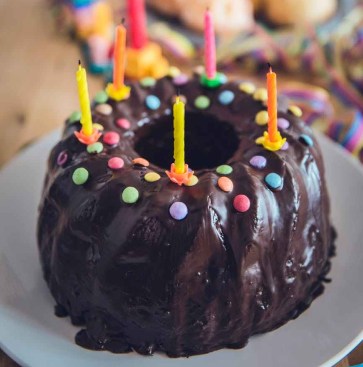 Stage 1. We could make a birthday cake from scratch, mixing basic ingredients, such as eggs, sugar and flour. This represents agrarian economies where commodities of raw materials (animal, mineral and vegetable) are extracted from the natural world.
Stage 2. Alternatively, we could buy cake mix where the ingredients are pre-made. This represents the shift to industrial economies where commodities are manufactured in standardised ways into goods to achieve economies of scale.
Stage 3. We could even buy a pre-made cake. This represents the shift to service economies where services are delivered, according to the needs of certain types of customers.
Stage 4. If we are really starved of time, we could outsource the entire birthday party and pay a company to throw the party for us- balloons, party hats and other decorations- and provide the cake for free. We’ve arrived at the experience economy. Experiences are staged to deliver goods or services in memorable ways. Experiences are personal unlike the impersonal nature of commodities, goods and services. Experiences engage us emotionally, physically, intellectually or even spiritually.
| Commodities | Fungible | Natural | Traded |
| Goods | Tangible | Standardised | Manufactured |
| Services | Intangible | Customised | Delivered |
| Experiences | Memorable | Personalised | Staged |
Narrative is at the core of experiences
Compelling experiences are themed in a concise and captivating way with a coherent storyline. The service or good being offered simply provides the stage and props to tell this story. Stimulating our senses enhances the theme to make it more memorable.
Competition, differentiation and needing to stand out from the crowd
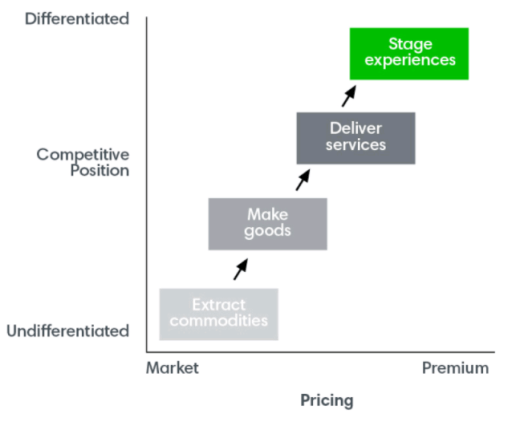
The move towards experiences is driven by increasing competition and differentiation so that products can stand out from their rivals.
- Commodities are undifferentiated and interchangeable, and remain in a raw form that needs processing before they can be used.
- Goods are more valuable than commodities. Their ingredients have been made into tangible products that can be used immediately.
- Services are more valuable than goods. People are willing to pay higher prices for services tailored and delivered according to their needs.
- Experiences are even more valuable. Once goods and services have become commoditised, wrapping them in an experience helps to differentiate them further. The experience of the product has become more valuable than the goods or services delivered. Of course, we’ll only pay extra if we feel the experiences is worth the price, requiring effective experience design.
 Blow Minds