
What sorts of experience are possible?
We can categorise experiences in two ways:
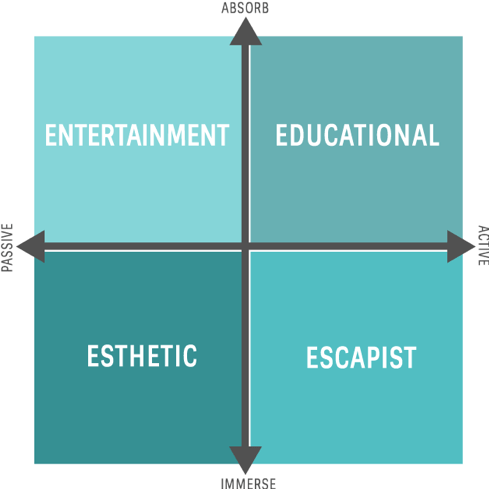
Degree of participation. People can participate as passive observers and not affect the performance at all, or they can be active and affect the performance.
Degree of connection. People’s minds can be totally absorbed or people’s bodies can be immersed. For example, our minds might be absorbed watching a film on TV at home but our bodies feel more immersed in the sights and sounds when watching at the cinema.
These two categories give rise to four types of experiences:
Entertainment experiences absorb our minds rather than immersing our bodies; for example, we watch plays, sitting passively in the audience.
Educational experiences also absorb our minds while also immersing our bodies so that we are more actively involved, such as attending a class or taking a sports lesson.
Escapist experiences focus on immersing our bodies so that we participate more actively. Compare acting in a play to taking notes in an literature class or playing in a band to sitting in a music lesson.
Aesthetic experiences focus on immersing our bodies in an activity or environment often in a passive way. Compare viewing the Grand Canyon to rock climbing or visiting an art gallery to painting a canvas.

Different experiences affect us differently
Entertainment experiences can alter our view of the world.
Educational experiences can make us rethink how we fit into that world.
Escapist experiences can boost our personal capabilities and characters.
Aesthetic experiences imbue new sense of wonder, beauty and appreciation.
 Blow Minds